
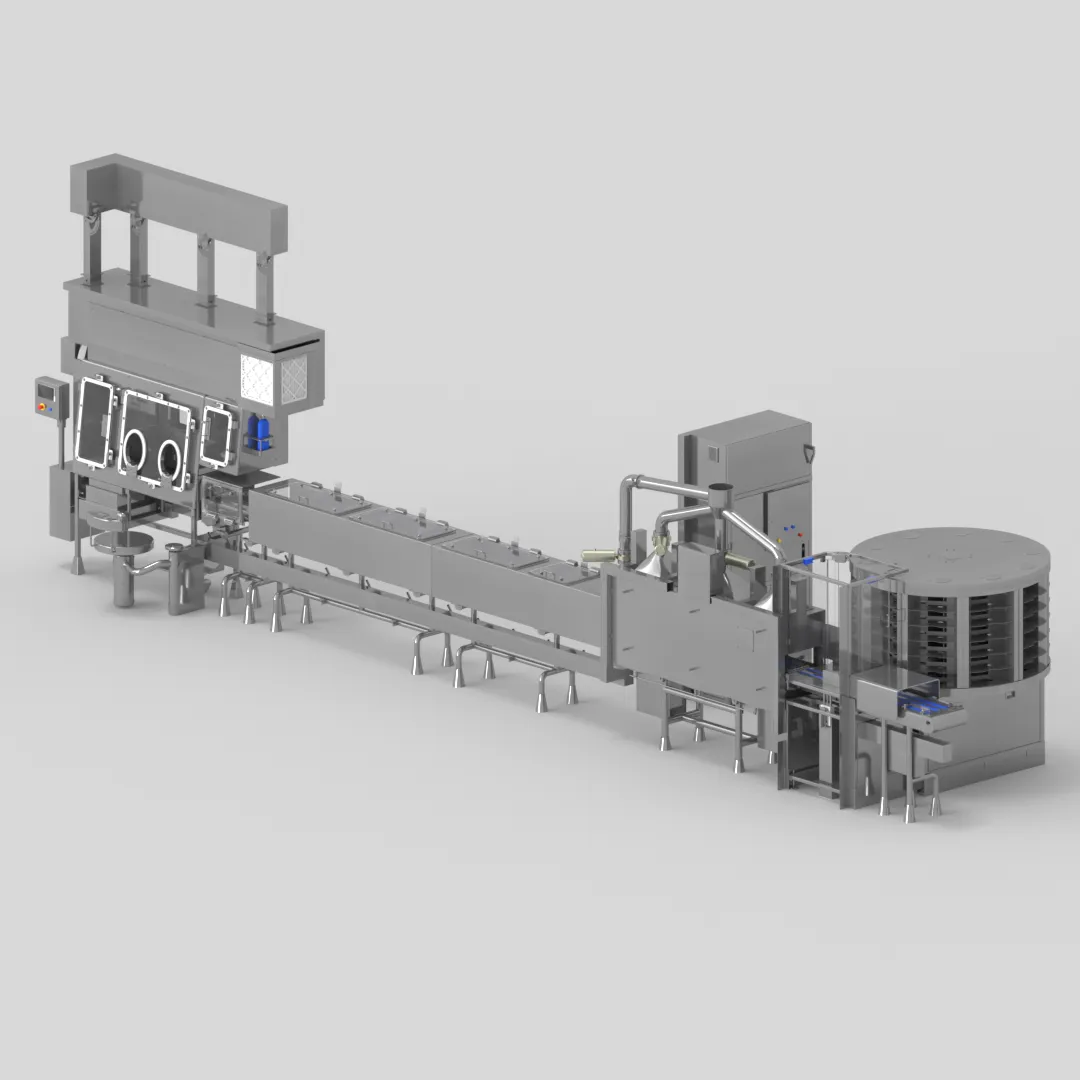
Nest/Tub Debagging and Decontamination Line
Automatic feeding carousel, spray decontamination and debagging under isolator for nests/tubs in sachets, at the start of the line.
Who is it for?
The line is aimed at pharmaceutical production sites that receive nests/tubs in sachets and must bring them into an isolator, in a sterile environment. Installed at the start of the line, it automatically distributes the nests/tubs still in their sachets, decontaminates them by spraying, then debags them under isolator. Like every SPC machine, it is custom-made to the needs of each site.
How does the line work?
Nests/tubs travel through four modules, from the feeding carousel to the isolator. The cycle runs in 4 steps:
- Automatic feeding: the carousel distributes the nests/tubs in sachets at the start of the line
- Spray decontamination of the nests/tubs, still in their sachets, in a dedicated chamber
- Contact time: a conveyor carries the sachets to the isolator while providing the contact time and fluid treatment
- Debagging under isolator: the debagging module takes the nests/tubs out of their sachets, in a sterile environment
- Automatic feeding carousel for nests/tubs in sachets, at the start of the line
- Spray decontamination in a dedicated chamber, before entry into the isolator
- Conveyor designed for contact time and fluid treatment
- Debagging module under isolator, for a sterile environment
- Four modules linked on a single line, from distribution to debagging
- Custom-made line for pharmaceutical applications, tailored to the needs of each site
Technical specifications
- Handled containers
- nests/tubs in sachets
- Nest/tub feeding
- automatic carousel, at the start of the line
- Decontamination
- by spraying, in a chamber, on nests/tubs still in their sachets
- Contact time and fluid treatment
- dedicated conveyor, between the decontamination chamber and the isolator
- Debagging
- module under isolator, for a sterile environment
- Output
- nests/tubs without sachet, under isolator
Compliance
- Debagging under isolator, designed for a sterile environment
Typical use cases
- Pharmaceutical production sites: bringing nests/tubs received in sachets into an isolator, in a sterile environment.
- Start of line: automatic distribution of nests/tubs in sachets by a carousel, upstream of the operations carried out under isolator.
- Spray decontamination of the sachets before they enter the isolator, followed by a contact time provided by conveyor.
- Debagging of nests/tubs under isolator, so that the sachet is only removed in a sterile environment.
- Custom projects: line designed with SPC Machines around the site's needs — throughput, nest/tub formats, isolator integration.
Everything about this machine
Four, on a single line: automatic feeding of the nests/tubs in sachets by a carousel, at the start of the line; their spray decontamination in a dedicated chamber; a conveyor that provides the contact time and fluid treatment; and finally debagging under isolator, for a sterile environment.
By spraying, in a decontamination chamber, while they are still in their sachets. The conveyor that follows provides the contact time and fluid treatment before entry into the isolator. The decontaminating agent and the contact time are to be defined with SPC Machines for your project.
Under isolator. The debagging module sits under an isolator designed for a sterile environment: the nests/tubs, decontaminated in their sachets upstream, are only taken out of them inside the isolator.
By an automatic feeding carousel, installed at the start of the line, which distributes the nests/tubs still in their sachets to the decontamination chamber. The carousel capacity and the line throughput are to be defined with SPC Machines according to your production.
Yes. SPC custom-builds its primary packaging and end-of-line machines to each customer's needs. Nest/tub formats, decontaminating agent, isolator integration and layout are reviewed with SPC Machines.

Our expertise enables us to offer a complete solution.
From technical expertise of your installations to the design of your future production tools.



.svg?dpl=dpl_FZtUgNG9dZJSbvQKyntje86izURw)